Shared holiday homes in Japan: a worked example
1. Why this piece
This is a worked example. Suppose you were considering entering the market for shared holiday homes in Japan. Which legal questions would decide the shape of your business, and how would those questions feed back into the design of the structure itself?
When a startup asks a corporate lawyer in Japan to confirm that a service is lawful, the deliverable usually arrives as a formal opinion. What follows is roughly how the substance of one is put together: start from the competitors, classify what they are doing, and only then ask which regulations attach.
This piece is a reworked version of material I presented to a bar association committee (17 March 2026, Sharing Economy Committee). It does not concern any client matter. It is a sample of the legal engineering I do.
2. The market
- Shared holiday homes have grown quickly in Japan, helped by coverage of offers priced around ¥50,000 a month.1
- Established property companies have entered in earnest; Nippon Steel Kowa Real Estate launched a multi-location living business in December 2025.2
- Remote work after the pandemic, the shrinking of urban living space as new apartment prices climbed, and the deepening problem of vacant houses have pushed both demand and supply upward.
- Only 0.7% of Japanese households own a secondary dwelling, holiday homes included (Ministry of Internal Affairs and Communications, 2023 Housing and Land Survey, p. 12).
- Yet 27.9% say they are interested in living across two locations (Ministry of Land, Infrastructure, Transport and Tourism, Recent Trends in Dual-Region Living (2023), p. 22).
3. The five structures
Shared holiday home businesses in Japan fall into five structures. The crux of the field is that which structure you choose determines which regulatory regime applies and which licences you need.
| Structure | Legal character | Form of the right | Examples |
|---|---|---|---|
| ① Co-ownership | Co-ownership of title under the Civil Code | Co-ownership share (a right in rem); inheritable and saleable | SANU 2nd Home Co-Owners, Nishigaki (Residence Villa), NOT A HOTEL, UMITO |
| ② Subscription | Accommodation contract / short-term building lease / platform terms of use (a listings model); some operators run properties directly | Contractual claim | SANU 2nd Home Weekday and Business, WITH SEA, ADDress, OURoom |
| ③ Membership or facility-use right | A continuing facility-use contract | Contractual claim; transferable subject to restrictions in the rules; significant risk of price decline | XIV, Tokyu Harvest Club (deposit model), Nishigaki (Grande) |
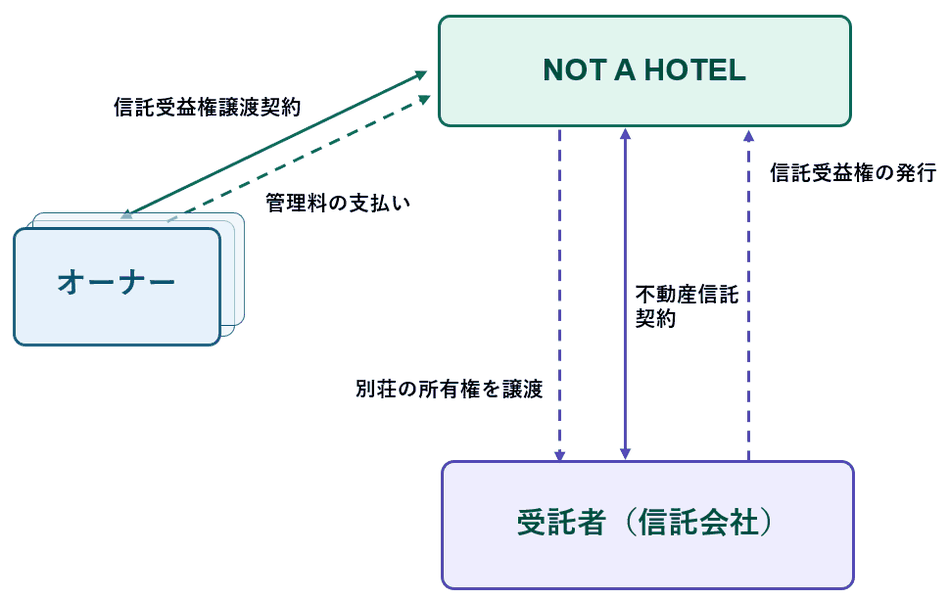
| ④ Trust beneficiary interest | Quasi-co-ownership of a real estate trust beneficiary interest | Title is held by the trustee; the owner holds the beneficiary interest, transferable as a security | NOT A HOTEL (certain properties) |
| ⑤ NFT | Accommodation right (a utility token) | A digital token with economic value; easily traded on; recorded on a blockchain | NOT A HOTEL DAO |
4. The structures in detail
① Co-ownership
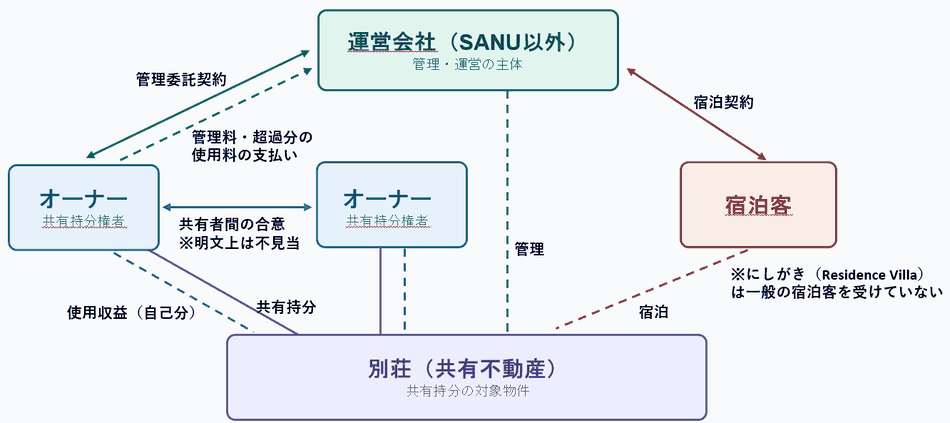
- The user becomes a co-owner of a share in the property.
- The relationship is governed first by the co-ownership provisions of the Civil Code, second by the co-owners' agreement on use and profit (an unnamed contract), and by the management agreement between the co-owners and the operator.
- Article 249 of the Civil Code allows each co-owner to use the whole of the property in proportion to its share. In practice, operators either allocate fixed periods (a timeshare) or take over management entirely and let third parties stay during periods the owner does not use.3
- Nights in excess of a co-owner's allocation are typically charged for, as at an ordinary hotel.
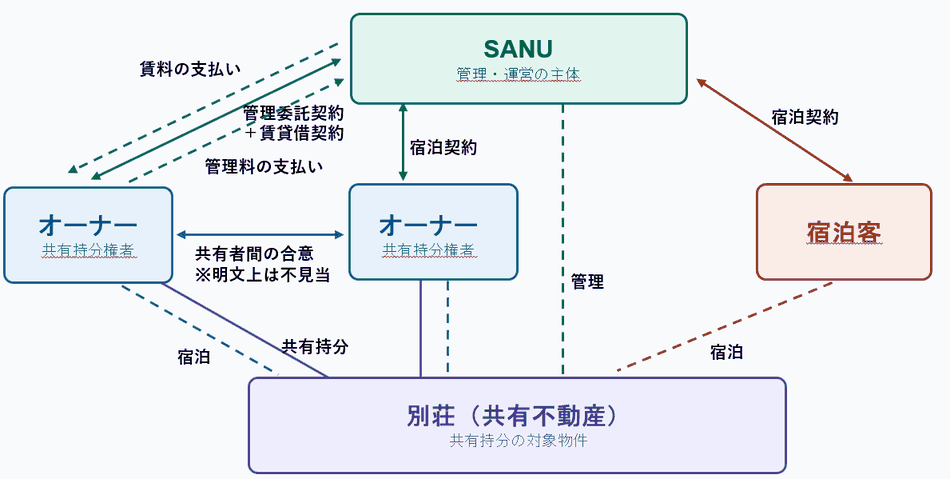
- Because the operator is generally engaged to handle cleaning, repairs and finding guests as a package, it will usually be an "administrator of the property in co-ownership" under Article 252-2 of the Civil Code.8
Issue: the legal basis for nights beyond the allocation
- Where a co-owner stays beyond its allocation, it is not obvious what the relationship is with the other co-owners or with the operator. Nishigaki's Residence Villa site, for instance, does not publish accommodation terms.45
- One reading is that the co-owner is not paying an accommodation charge at all but consideration for use under Article 249(2) of the Civil Code, which the operator collects as agent. If so, a separate question arises: whether registration as a funds transfer service provider under the Payment Services Act is required.67
- SANU takes a different route: the co-owner leases the property to SANU, and then enters into an accommodation contract with SANU. Its terms define a Co-Owners member as a person who "purchases a co-ownership share in the relevant accommodation facility and leases that facility to the Company", and its accommodation terms are expressed to govern the accommodation contract with members including co-owners (SANU 2nd Home Co-Owners Terms of Use, art. 2(2); SANU 2nd Home Accommodation Terms). Putting the relationship expressly into the contracts makes this a design worth studying.9
② Subscription
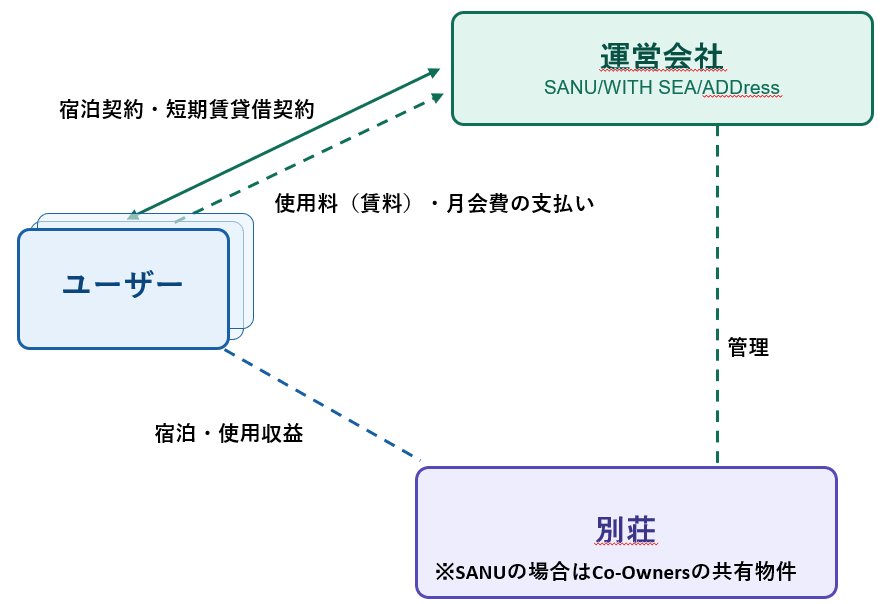
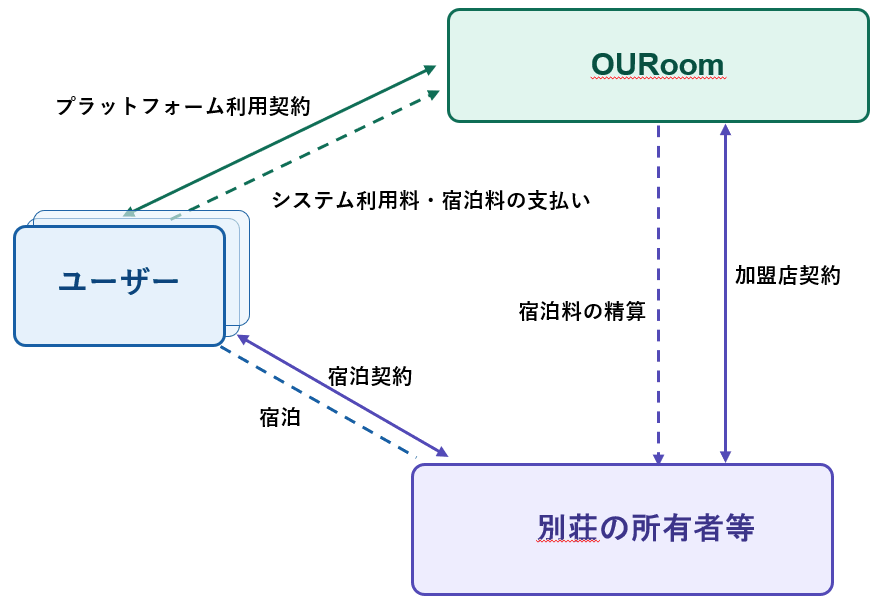
Contracts between operator and user fall into three types:
- Accommodation contract (SANU, WITH SEA)
- Short-term building lease (ADDress)
- Platform terms of use (OURoom)
Issue: a subscription you get back
- SANU 2nd Home Weekday markets itself as a subscription that is not simply spent: the monthly fee accrues as "S2O points" and can be applied in full to the purchase price of a SANU 2nd Home Co-Owners property.
- The scheme is described as accumulating the monthly fee (excluding tax) for application to the purchase price. In legal terms this is probably best characterised as a conditional right to set off against the price, or a discount voucher. More precisely, the question is whether it is structured, like points and electronic money generally, as an assumption of debt or an assignment of claims.10
Issue: hotel business licensing (Inns and Hotels Act, art. 2(1)) — ADDress
- The operator leases properties from owners and makes them available to members. Members pay monthly and can use locations nationwide, but stays can be short — a single night is possible — which raises the question whether this is "accommodation" or "residence".
- A hotel business is defined as "the business of allowing persons to stay for a charge". The Ministry of Land, Infrastructure, Transport and Tourism distinguishes it from residential letting by asking (i) whether, looking at the management and operation of the facility as a whole, responsibility for hygiene in the rooms including occupied rooms rests with the operator as a matter of ordinary understanding, and (ii) whether the guest has the base of their life in the room they occupy.11
- A one-night minimum means the guest almost certainly does not have the base of their life there, so for very short stays there is a real possibility that the participating owner is found to be running a hotel business.12
- Asking participating owners to bear the cost of hotel licensing, however, makes them harder to recruit, which undermines the model.
- Abandoning the participating-owner model and operating only directly held properties then raises the funding question. Where a company's own capital is insufficient, it must raise money broadly from investors through a GK-TK structure or a real estate specified joint enterprise — structures that are themselves complex and expensive to set up, and hard for a venture to adopt. This is a textbook case of a legal characterisation feeding straight back into the choice of capital structure.13
Issue: travel agency services (Travel Agency Act, art. 2(3)) — OURoom
- OURoom positions itself purely as a listings site, but collects a monthly fee of ¥1,000. Whether that is a handling fee within the meaning of the Travel Agency Act — such that the business requires registration — is the question.14
- It could be explained as a system usage fee, and the amount is small, so there may be an internal judgement that the practical risk of being challenged is low.
- On the other hand, Jalan (Recruit), the best-known listings site in the Japanese travel sector, does not charge users a system fee. Against that comparison, collecting consideration from the user for the introduction of accommodation, however small, tends towards a finding that travel agency services are being provided.15
- OURoom also handles payment collection for accommodation charges, and the Japan Tourism Agency takes the view that the Travel Agency Act applies to a listings-type OTA where it handles payment. On that basis there is a real possibility that this model is found to contravene the Act.16
③ Membership and facility-use rights
- The most traditional model.
- Like golf club memberships, these are transferable claims with some asset value, but the rules typically require the operator's consent to any transfer to a third party and impose a lock-up period.
- Prices often fall well below the purchase price, so these tend to be bought less for wealth building than as a corporate tax measure, booked as a welfare expense.
Issue: whether the deposit is a "deposit taking" — Tokyu Harvest Club (deposit model)
- Under this service a member deposits a sum for a fixed period, receives a deposit certificate and obtains the right to use the facilities. The deposit is stated to be returned in full, without interest or dividend, on withdrawal (or at the end of the holding period). Whether this contravenes the deposit-taking restriction in the Act Regulating the Receipt of Contributions is the question.17
- "Deposit taking" requires all of the following: (i) an unspecified and large number of counterparties; (ii) receipt of money; (iii) a promise to return the principal; and (iv) a purpose of holding the value of the money principally for the convenience of the depositor.18
- The deposit here is not held "for the convenience of the depositor" in the way a bank deposit is; it functions as security for, and consideration under, the membership contract. It is therefore arguable that it is not deposit taking.
- National Tax Agency materials also treat a deposit paid on acquiring a resort membership as property carrying a right of return on withdrawal in certain circumstances. As a payment recognised in public materials, the practical risk of enforcement under the Act appears limited.1920
④ Trust beneficiary interest
- Title is transferred to a trustee such as a trust bank, and the economic benefit — the right to use the property and the income it generates — is conferred as a trust beneficiary interest.
- Because the owner holds a beneficiary interest (a quasi-co-ownership share) rather than the real estate itself, transaction costs on transfer, and direct exposure to management responsibility and owner's liability for structures under Article 717 of the Civil Code, are reduced.21
- On secondary transfers, the interest is a deemed security under the Financial Instruments and Exchange Act (art. 2(2)(i)), so registration as a Type II financial instruments business is required (art. 2(8), art. 28(2)(ii)).2223
⑤ NFT and tokens
- An NFT is itself neither title nor a contractual claim; it is understood as a digital token carrying some economic value.24 Services attached to an NFT are provided under the contract between issuer and holder.25
- NFTs trade on easily, and transfers can be recorded on a blockchain.
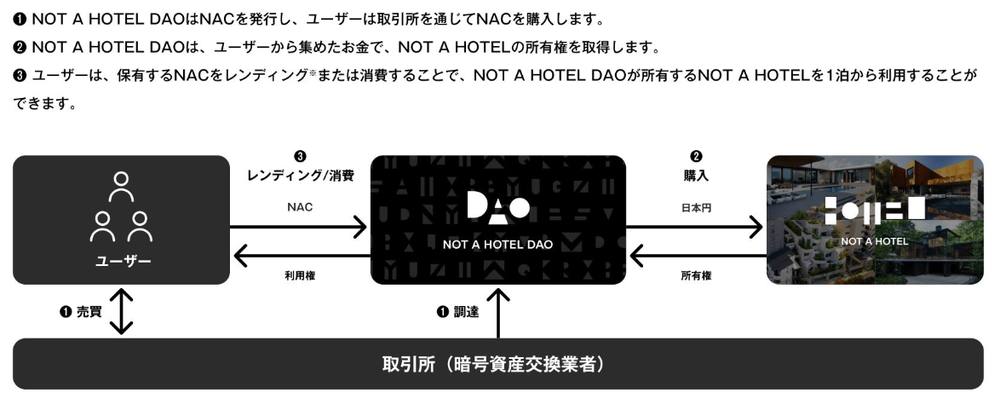
- NOT A HOTEL DAO issues a crypto asset, NAC, through which users participate in governance and in revenue opportunities.
- NAC is treated as a crypto asset under the Payment Services Act. To avoid being characterised as a security under the Financial Instruments and Exchange Act, it is deliberately structured as a utility token — carrying a right to use the hotels — with no guarantee of principal and no profit distribution.
- Users lend NAC to NOT A HOTEL DAO and receive use rights in return. Structuring this as a loan for consumption of crypto assets keeps it outside the Money Lending Business Act and the Payment Services Act.2627
- Even so, the possibility cannot be entirely excluded that a scheme in which money paid up front is converted into NAC and then applied to hotel accommodation amounts to a prepaid payment instrument regulated under the Payment Services Act. This is worth watching.
5. Recent legislative changes
Civil Code amendments (in force April 2023) — easier management of co-owned property
- Wider scope for acts of management: under amended Article 252, anything short of a material alteration of the form or utility of the property can be decided by a majority of shares as an act of management.
- A statutory administrator: Article 252-2 allows the operator to act as an "administrator" on a firm legal footing.
- Missing co-owners: Articles 251(2) and 252(2) permit alteration and management with the consent of the remaining co-owners alone, on court approval.
Relaxation of hotel licensing requirements
- In response to the spread of private lodging, requirements such as the front desk have been relaxed.28
- Many shared holiday home operators deliberately obtain a "simple lodging" licence under the Inns and Hotels Act rather than register under the Private Lodging Business Act, avoiding the 180-day cap and allowing year-round operation.
Amendments to the Vacant Houses Special Measures Act (in force December 2023)
- A new category of "inadequately managed vacant house" was added alongside "specified vacant house".29
- Where a municipality issues a recommendation designating a property as inadequately managed, the residential land special measure for fixed asset tax (a reduction of up to five-sixths) is withdrawn. Simply continuing to own a holiday home can multiply the tax burden, which itself pushes supply towards sharing services.
- "Vacant house utilisation promotion zones" were created, streamlining change-of-use and rebuilding restrictions within designated areas. Relaxation of road-frontage requirements is included, making conversion to shared holiday homes easier.30
Dual-Region Living Promotion Act (in force November 2024)
- Municipal heads may now designate "dual-region living support corporations".31
- Within a planned zone, relaxed use restrictions in residential districts make it easier to develop shared offices, coworking space and short-stay facilities.
6. Current obstacles and practical points
Stricter local ordinances
- Article 18 of the Private Lodging Business Act allows a local government, where necessary to prevent deterioration of the living environment, to restrict the operating period by ordinance.
- In established resort areas such as Karuizawa, summer restrictions and noise rules are strict, and the limits imposed can fall well below the 180 days the statute allows.
- Any assessment of a business model therefore has to include a comprehensive review of the relevant municipality's ordinances.
Amending the rules of a condominium
- Where the property is a unit in a condominium, the Act on Unit Ownership can be an obstacle.
- Many management associations prohibit private lodging and sharing in their by-laws, out of concern that a stream of unidentified visitors weakens security. Amending the by-laws requires a resolution passed by three-quarters of both the unit owners and the voting rights (Act on Unit Ownership, art. 31(1)), and building that consensus is extremely difficult.
Owner's liability and the limits of exclusion clauses
- Liability for structures on land under Article 717 of the Civil Code is strict liability for the owner.
- If a guest is injured by a defect in the property during a shared stay, the registered co-owners bear the liability in damages.
- An indemnity in the management agreement does not exclude liability as against the injured third party.
- Insurance therefore has to be arranged to hedge this exposure, and it is a point counsel acting for a user should always check.
7. Models to expect, and the legal questions they raise
DAO-based management integrated with the local community
- A model in which NFT holders vote on how the property is run, using the mechanics of a decentralised autonomous organisation. A further variant has local residents as well as NFT holders participate in the DAO and receive rewards for managing the property and maintaining its surroundings.32
- The legal difficulty is that the status of a DAO under Japanese law is still unsettled.
- Amendments to the Cabinet Office Ordinance under the Financial Instruments and Exchange Act in 2024 opened the way to DAOs in the form of a limited liability company (previously they were sometimes analysed as voluntary partnerships), but the legal character of tokens transferred to local residents as "rewards" has yet to be worked out.33
This piece is general information, not legal advice on any particular matter. Descriptions of the services referred to are based on publicly available information as understood at the time of writing; the actual structures and terms may differ.
Notes
- Article on Business+IT
- Nippon Steel Kowa Real Estate news release, 24 December 2025
- NOT A HOTEL, "About NOT A HOTEL"
- Accommodation terms are not required to be prepared or published under the Inns and Hotels Act, but as standard terms under the Civil Code they are frequently posted on the operator's website.
- By contrast, neither the NOT A HOTEL accommodation terms nor those of the individual UMITO hotels exclude co-owners from the class of guests, which suggests that in those services the co-owner contracts for accommodation in the same position as an ordinary guest.
- To avoid characterisation as an exchange transaction, the operator needs authority from the other co-owners to collect as their agent. Whether that authority is conferred by the management agreement, or is taken to follow automatically from appointment as administrator of the co-owned property, is unclear on the available information. In practice the amount corresponding to the accommodation charge is presumably set off against the management fees the administrator charges each co-owner rather than being remitted to them, but that analysis is not apparent from the wording either.
- Some collection agency services (bill-splitting apps and the like) were brought within the funds transfer regime by amendments to the Payment Services Act, but collection in the co-ownership model is presumably treated as outside the scope as a platform-type arrangement (Payment Services Act, art. 2-2; Funds Transfer Ordinance, art. 1-2(iii)(b)).
- The published terms leave the content of the co-owners' agreement and the process for appointing the administrator opaque.
- On the third sentence of note 6 above, there is a provision in SANU 2nd Home Co-Owners Terms of Use, art. 7(3).
- Nakamori et al., Virtual Money: The Law (2nd ed., 2018), pp. 124 ff.
- Ministry of Land, Infrastructure, Transport and Tourism, private lodging portal (Inns and Hotels Act)
- In the view of Mr Ishii, an administrative scrivener with a deep knowledge of the legal framework of the travel sector, one month is the dividing line (Commentary on the Inns and Hotels Act).
- For an overview of these structures, see Ministry of Land, Infrastructure, Transport and Tourism, Real Estate Securitisation and Real Estate Specified Joint Enterprises.
- OURoom Terms of Use, art. 2.
- Recruit did obtain a Type III travel agency registration in 2018, but that was presumably required for the resale of dynamic packages such as the JAL Jalan Pack.
- Japan Tourism Agency, Travel Agency Act Enforcement Guidelines, Part 1, 1, 6; Japan Tourism Agency, Guidelines on Representations in Online Travel Transactions (June 2015).
- Tokyu Harvest Club, how the membership works
- Financial Services Agency, administrative guidelines (deposit taking)
- National Tax Agency, FAQ on property valuation, Q34.
- There is a counter-argument. Deposits for golf club memberships are governed by the Act on Proper Management of Membership Contracts for Golf Courses (Act No. 53 of 1992); if that Act is understood as special legislation displacing the Act Regulating the Receipt of Contributions, it can be argued that deposits for resort memberships remain deposit taking and that the general Act applies.
- One consequence is that the Real Estate Brokerage Act does not apply, so protective measures under art. 33-2(ii) of that Act are unnecessary.
- NOT A HOTEL holds the licence through a separate entity.
- Primary transactions are treated as self-offering by the issuer of the beneficiary interest and, in principle, do not constitute a financial instruments business (Financial Instruments and Exchange Act, art. 2(8)(vii)(g); Enforcement Order, art. 1-9-2).
- Ministry of Economy, Trade and Industry, Interpretative Guidelines on Electronic Commerce and Information Property Trading (February 2025), p. 327.
- Ibid., p. 329.
- NOT A HOTEL COIN loan-for-consumption terms, art. 6.
- Providing staking — where the custodian has a segregation obligation and the user can withdraw — requires registration as a crypto asset exchange service provider (Payment Services Act, art. 2(15)) (discussion).
- Commentary
- Ministry of Land, Infrastructure, Transport and Tourism materials on the Vacant Houses Special Measures Act
- Ministry of Land, Infrastructure, Transport and Tourism, Vacant House Utilisation Promotion Zones: Scope and Guidelines
- Ministry of Land, Infrastructure, Transport and Tourism, Towards Implementation of the Dual-Region Living Promotion Act
- NOT A HOTEL DAO does set the rules governing its tokens centrally, so it differs in important respects from a typical DAO.
- Japan Crypto Business Association, Guidelines for Building Regional Revitalisation DAOs (12 December 2023)